

When people talk about childhood, old routines, or places that have changed, they often use used to. For example, “I used to walk to school” describes a regular activity in the past and suggests that walking to school is no longer part of the speaker’s routine.
The negative form, didn’t use to, describes something that was not true during an earlier period: “I didn’t use to enjoy reading.” This guide explains how to form both expressions, when to use them, and how they differ from similar phrases.
In This Page
What Do Used To and Didn’t Use To Mean?
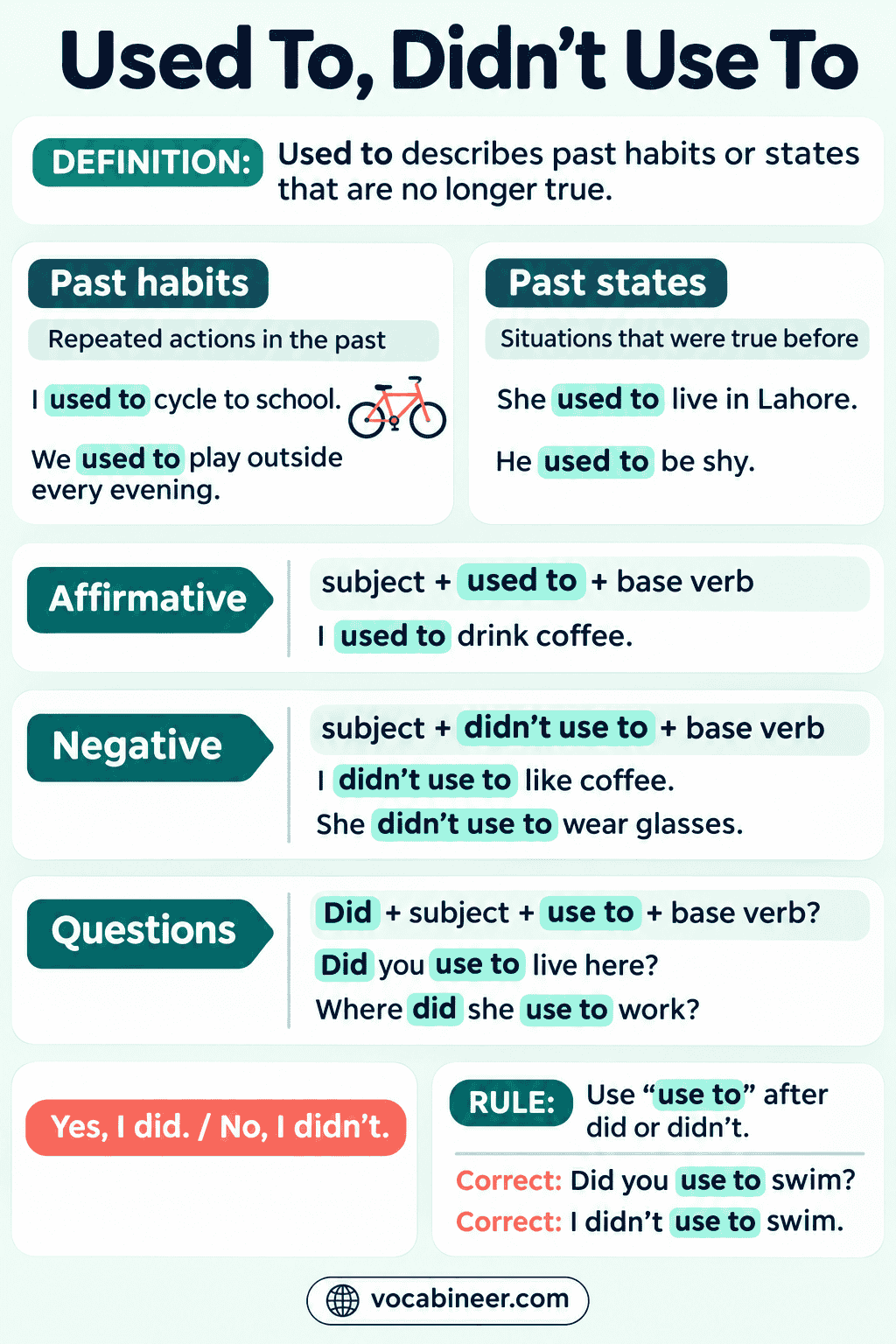
Used to + base verb describes a past habit or state. It usually suggests that the situation has changed.
I used to live near the beach.
The speaker lived near the beach in the past and probably does not live there now.
Didn’t use to + base verb describes a habit or state that was absent in the past.
I didn’t use to like coffee.
This tells us about the speaker’s past preference. It does not, on its own, tell us whether the speaker likes coffee now. To make the change clear, add present context: “I didn’t use to like coffee, but now I drink it every morning.”
How to Form Sentences with Used To
Follow used to or didn’t use to with the base form of a verb, such as play, live, or like.
| Sentence type | Structure | Example |
|---|---|---|
| Affirmative | Subject + used to + base verb | She used to play tennis. |
| Negative | Subject + didn’t use to + base verb | She didn’t use to play tennis. |
| Question | Did + subject + use to + base verb? | Did she use to play tennis? |
| Short answer | Yes, subject + did. / No, subject + didn’t. | Yes, she did. / No, she didn’t. |
In standard edited English, write used to in affirmative sentences but use to after did or didn’t. The auxiliary did already marks the past:
- We used to visit them every weekend.
- We didn’t use to visit them often.
- Did you use to visit them?
You can also use never used to to say that something did not happen during a past period: “He never used to eat breakfast.” Because this form does not contain did, it keeps used.
When to Use Used To
Past habits
Use used to for activities that happened regularly during an earlier period. You do not need to state exactly when the habit stopped.
- We used to ride our bikes after school.
- My father used to read to us at bedtime.
- She used to take the train to work.
Each sentence describes a former routine. None refers to just one occasion.
Past states and situations
Used to also works with states: conditions, possessions, preferences, and circumstances that were true in the past.
- I used to live in a small apartment.
- He used to have long hair.
- This building used to be a library.
To describe the former existence of a place or thing, use there used to be:
There used to be a bakery on this street.
This means a bakery existed there in the past and suggests that it is no longer there.
When to Use Didn’t Use To
Use didn’t use to for something that was not a habit or was not true in an earlier period.
- I didn’t use to cook at home.
- She didn’t use to enjoy long walks.
- We didn’t use to have a car.
These sentences tell us what was true then. If the present situation matters, state it:
We didn’t use to have a car, but we have one now.
In everyday speech, the forms used to and use to can sound very similar. In writing, keep the d in an affirmative sentence and leave it off after didn’t or did.
Used To Compared with Similar Expressions
Several expressions refer to past routines or familiarity. Their meanings and structures differ.
| Expression | Use | Example |
|---|---|---|
| Used to + base verb | A past habit or state, usually with a present contrast | I used to walk to work. |
| Would + base verb | A repeated past action, usually within an established past setting | When I was young, we would walk to the river. |
| Simple past | A past action or fact; a present contrast is not required | I walked to work yesterday. |
| Be used to + noun or -ing form | Be accustomed to something | I am used to walking to work. |
| Get used to + noun or -ing form | Become accustomed to something | I am getting used to walking to work. |
Used To and Would
Both can describe repeated past actions: “We used to swim there every summer” and “Every summer, we would swim there.” However, would usually needs a clear past setting and generally cannot replace used to when describing a past state.
| Past meaning | Natural sentence | Why |
|---|---|---|
| Repeated action | When we were children, we would play outside until dark. | Would describes a recurring activity. |
| Former state | I used to live in that village. | Used to describes a past living situation. |
Used To and the Simple Past
The simple past can describe one completed event or a past routine. Used to specifically presents a habit or state as part of an earlier period and usually suggests that things have changed.
| Sentence | Meaning |
|---|---|
| I visited my grandmother yesterday. | One completed visit. |
| I visited my grandmother every Sunday. | A past routine; the sentence alone does not emphasize a present change. |
| I used to visit my grandmother every Sunday. | A former routine that is probably no longer typical. |
Used To, Be Used To, and Get Used To
These expressions look alike, but they answer different questions.
| Expression | Question it answers | Example |
|---|---|---|
| Used to + base verb | What happened or was true in the past? | She used to wake up early. |
| Be used to + noun or -ing form | What feels familiar now? | She is used to waking up early. |
| Get used to + noun or -ing form | What is becoming familiar? | She is getting used to waking up early. |
The word to is followed by a base verb in past-habit used to. In be used to and get used to, it is followed by a noun or an -ing form.
Common Mistakes with Used To
| Incorrect | Correct | Why |
|---|---|---|
| I didn’t used to drive. | I didn’t use to drive. | Didn’t already marks the past. |
| Did you used to live here? | Did you use to live here? | Use use to after did. |
| She used to playing tennis. | She used to play tennis. | Past-habit used to takes a base verb. |
| I am used to wake up early. | I am used to waking up early. | Be used to takes a noun or an -ing form. |
| I used to meet her once yesterday. | I met her once yesterday. | Use the simple past for one completed event. |
A sentence with used to describes a repeated action or a past state. Words such as once yesterday point to a single event, so the simple past fits better.
Everyday Examples
The following examples show how the forms work in familiar situations.
| Situation | Example |
|---|---|
| Childhood | I used to collect stamps when I was a child. |
| School | Did you use to walk to school? |
| Work | She used to work in a bookstore. |
| Transport | We didn’t use to take the bus, but we do now. |
| Preferences | He didn’t use to like spicy food. |
| Places | There used to be a park behind this building. |
Frequently Asked Questions
Use didn’t use to in standard edited English: “I didn’t use to drink tea.” The auxiliary didn’t carries the past tense, so use appears without the final d.
Yes. It can describe a former home, job, possession, preference, or condition: “She used to live in London” and “This room used to be an office.”
It usually suggests that the past habit or state has changed. However, the speaker may need to add more context if the present situation is important: “I used to play chess every day, and I still play occasionally.”
Both can describe repeated past actions. Would typically needs an established past setting, while used to can also describe past states, such as “I used to own a bicycle.”
Used to + base verb describes a past habit or state: “I used to work nights.” Be used to + noun or -ing form means something feels familiar: “I am used to working nights.”
Conclusion
Use used to + base verb for a past habit or state, and didn’t use to + base verb for something that was absent in the past. In questions, use Did + subject + use to + base verb? These forms make changes easy to express: “I used to stay up late, but now I go to bed early.”
Read More
- Verbs in English
- Action Verbs
- Regular Verbs
- Irregular Verbs
- Transitive and Intransitive verbs
- Finite and Non-finite verbs
- Principal Parts of Verbs
- Forms of Verbs