

Mina is tall. Sara is taller than Mina, but Aisha is the tallest person in the group. These sentences show how an adjective can describe a quality, compare two people, or rank one person within a group.
Comparative and superlative adjectives help you make these comparisons clearly. Their forms depend on the adjective, so you may add -er or -est, use more or most, or learn an irregular form. This guide explains the patterns, spelling rules, and common mistakes with practical examples.
In This Page
What Are Comparative and Superlative Adjectives?
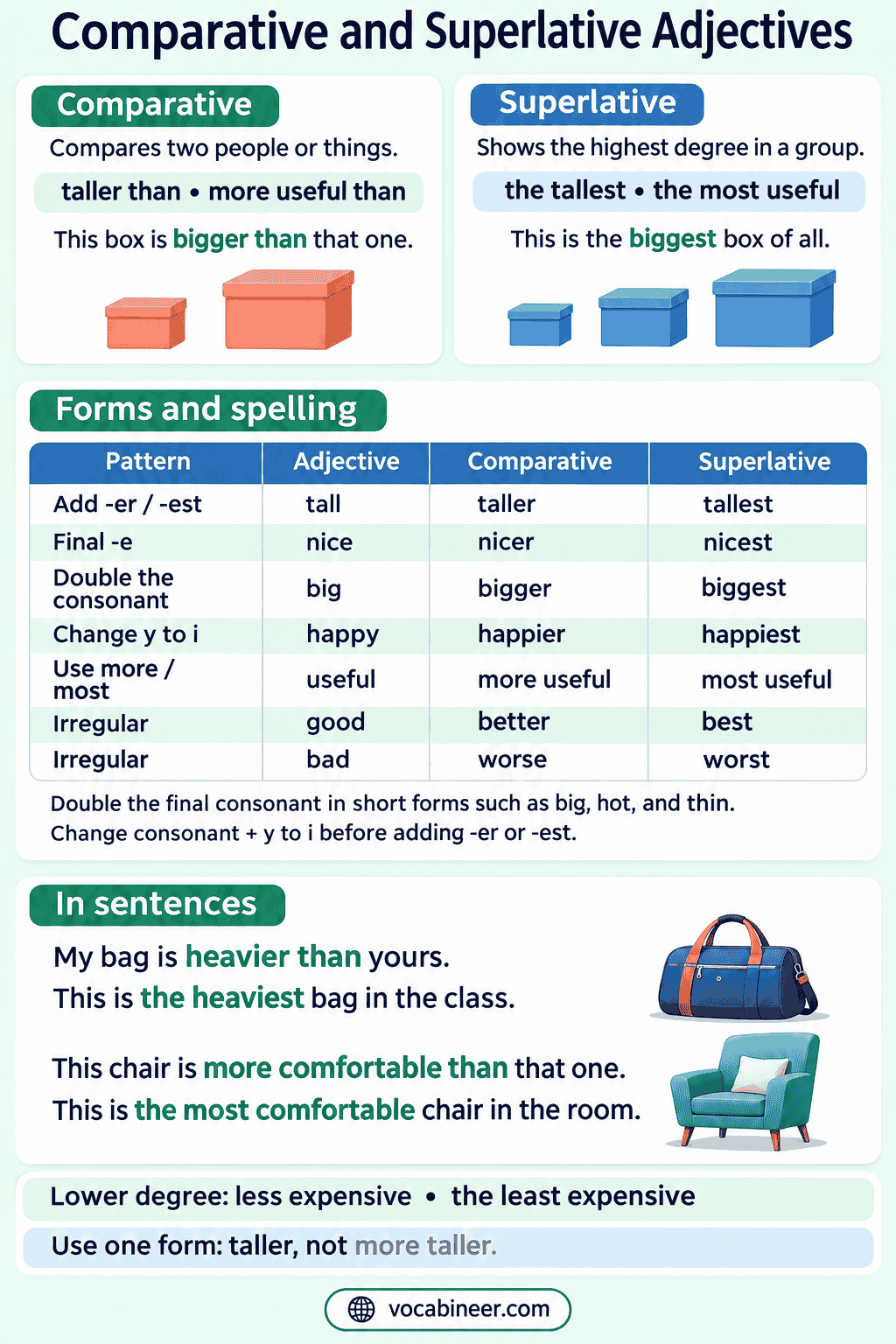
A comparative adjective compares the degree of a quality between two people, things, places, or groups. A superlative adjective identifies the highest or lowest degree within a group.
| Form | Use | Example |
|---|---|---|
| Comparative | Compare two items | This road is wider than that one. |
| Superlative | Rank one item within a group | This is the widest road in town. |
In standard grammar instruction, use a comparative when comparing two items and a superlative when ranking one item among three or more. The comparison group should be clear from context.
How to Form Comparative Adjectives
Short adjectives often take -er. Many longer adjectives use more. To express a lower degree, use less before the adjective.
- This chair is softer than the wooden one.
- The blue bag is more expensive than the black bag.
- Today is less windy than yesterday.
Comparative spelling rules
| Adjective pattern | How to form the comparative | Example |
|---|---|---|
| Most one-syllable adjectives | Add -er | short → shorter |
| Adjective ending in silent e | Add -r | wide → wider |
| Consonant + y | Change y to i, then add -er | happy → happier |
| Short vowel + final consonant | Usually double the final consonant and add -er | hot → hotter |
| Many longer adjectives | Put more before the adjective | careful → more careful |
| Lower degree | Put less before the adjective | crowded → less crowded |
Use than when you name the second item in an unequal comparison:
A train is faster than a bus.
You can leave out than when the comparison target is already understood:
The weather is getting warmer.
How to Form Superlative Adjectives
Superlatives identify the highest or lowest degree within a group. Short adjectives usually take -est, while many longer adjectives use most. Use least to express the lowest degree.
- It was the coldest day of the month.
- That was the most exciting match of the season.
- This is the least expensive option.
Superlative spelling rules
| Adjective pattern | How to form the superlative | Example |
|---|---|---|
| Most one-syllable adjectives | Add -est | short → shortest |
| Adjective ending in silent e | Add -st | wide → widest |
| Consonant + y | Change y to i, then add -est | happy → happiest |
| Short vowel + final consonant | Usually double the final consonant and add -est | hot → hottest |
| Many longer adjectives | Put most before the adjective | careful → most careful |
| Lowest degree | Put least before the adjective | crowded → least crowded |
Superlatives commonly use the:
- the best answer
- the largest room
- the most useful tool
However, another determiner can take the place of the:
- my best result
- her most useful idea
Irregular Comparative and Superlative Forms
Some common adjectives do not follow the usual -er/-est or more/most patterns. Learn their forms as a group.
| Positive | Comparative | Superlative |
|---|---|---|
| good | better | best |
| bad | worse | worst |
| far | farther/further | farthest/furthest |
| little | less | least |
| many/much | more | most |
Farther often refers to physical distance: “The next station is farther away.” Further can refer to distance or additional extent: “For further information, ask the guide.” In everyday usage, the two forms can overlap when discussing distance.
Choosing Between Comparatives and Superlatives
Use a comparative for a direct comparison. Use a superlative to rank an item within a group.
| Meaning | Example |
|---|---|
| Describe a quality | The room is warm. |
| Compare two items | This room is warmer than the kitchen. |
| Rank within a group | It is the warmest room in the house. |
You can use one of the + superlative + plural noun to say that something belongs to a group of top-ranked items:
This is one of the most popular parks in the city.
The noun after one of the is plural: one of the best books, not one of the best book.
Equal and Unequal Comparisons
Comparatives and superlatives are not the only ways to compare qualities. Use these patterns to show equality or a lower degree:
| Pattern | Meaning | Example |
|---|---|---|
| as + adjective + as | Equal degree | The blue bag is as light as the red one. |
| not as/so + adjective + as | Lower degree | This path is not as steep as that one. |
| less + adjective + than | Lower degree | This route is less crowded than the main road. |
Use the adjective’s positive form after as and less: “as fast as,” not as faster as.
Common Mistakes with Comparatives and Superlatives
| Incorrect | Correct | Why |
|---|---|---|
| more taller | taller | Do not combine more with an -er form. |
| most easiest | easiest | Do not combine most with an -est form. |
| taller as her brother | taller than her brother | Use than for an unequal comparison. |
| the most tallest | the tallest | Avoid double superlative marking. |
| the my best result | my best result | Do not normally combine the with a possessive determiner. |
| one of the best book | one of the best books | Use a plural noun after one of the. |
| This one is better. | This one is better than the other one. | Name the comparison target when the reader needs it. |
For a direct comparison between two items, standard teaching grammar favors the comparative: “Of the two routes, this one is shorter.” Use a superlative when ranking an item in a group: “Of the three routes, this one is the shortest.”
Comparative and Superlative Adjectives in Sentences
The table shows the positive, comparative, and superlative forms of common adjectives.
| Positive | Comparative | Superlative |
|---|---|---|
| fast | faster | fastest |
| wide | wider | widest |
| happy | happier | happiest |
| hot | hotter | hottest |
| careful | more careful | most careful |
| expensive | less expensive | least expensive |
| good | better | best |
| bad | worse | worst |
Here are more examples in everyday contexts:
- People: My brother is younger than me.
- School: This was the most difficult question on the test.
- Food: The soup is spicier than the salad.
- Weather: Today is less windy than yesterday.
- Travel: Of the three routes, this one is the safest.
- Objects: This laptop is lighter than my old one.
- Books: It is one of the funniest books in the series.
- Work: The second task was easier than the first.
Not every adjective naturally takes comparative or superlative forms. Words that describe materials, such as wooden, do not usually form comparisons. Adjectives expressing absolute qualities, such as unique, are also often treated as non-gradable in careful writing, although people sometimes use forms such as more unique informally.
Frequently Asked Questions
Use a comparative to compare two items, as in “This road is narrower than that one.” Use a superlative to rank one item within a group, as in “This is the narrowest road in the area.”
Short adjectives usually take -er, as in faster. Many longer adjectives use more, as in more comfortable. Some two-syllable adjectives allow more than one form; choose the version that sounds natural and is commonly used.
No. Use than when you name the second item: “My room is larger than yours.” You can omit it when the comparison is clear: “My room is getting larger.”
They commonly use the, as in “the tallest building.” A possessive or another determiner can replace it: “my tallest building” or “her best score.”
No. Many adjectives describe qualities that do not naturally have degrees, such as wooden. Some adjectives, including unique, are traditionally treated as absolute, though speakers may use comparative forms informally.
Conclusion
Comparative adjectives compare qualities, while superlative adjectives rank one item within a group. Form them with -er/-est or more/most, follow the spelling patterns, and use than when naming the second item. For example: fast, faster, fastest; careful, more careful, most careful.
Read More