

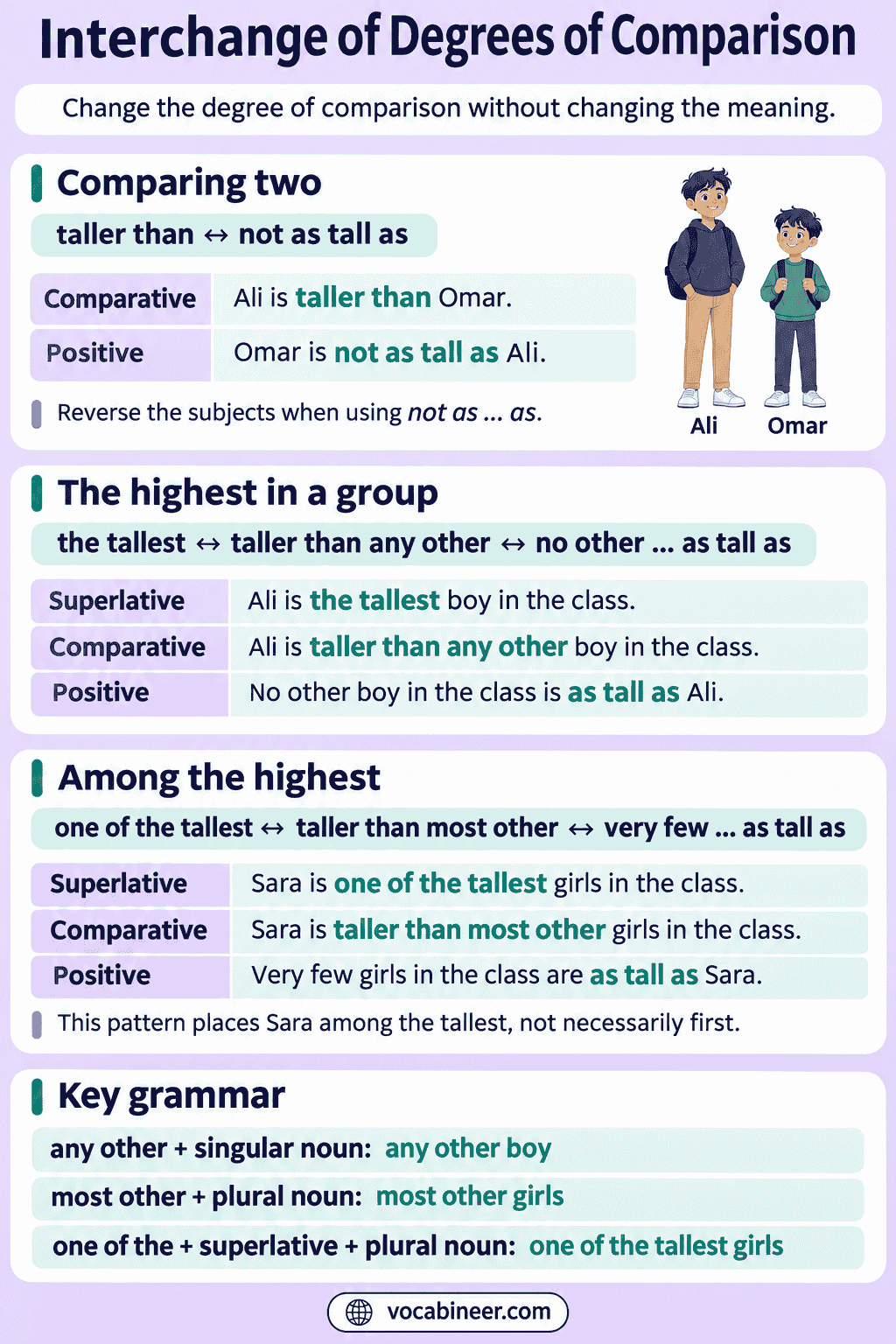
The same comparison can be expressed in three ways: “No other runner in the race is as fast as Ali,” “Ali is faster than any other runner in the race,” and “Ali is the fastest runner in the race.” Each sentence places Ali at the top of the same group.
This rewriting process is called the interchange of degrees of comparison. It changes a sentence from the positive, comparative, or superlative form while keeping its main meaning. To do it accurately, preserve the subject, comparison group, and ranking. This guide explains the common patterns and shows when a rewrite needs extra care.
In This Page
What Is the Interchange of Degrees of Comparison?
Degrees of comparison show how a quality applies or compares:
| Degree | Example | Meaning |
|---|---|---|
| Positive | Ali is as fast as the other runners. | Describes a quality without ranking it. |
| Comparative | Ali is faster than any other runner. | Compares Ali with the rest of the group. |
| Superlative | Ali is the fastest runner. | Ranks Ali above the group. |
In traditional grammar exercises, interchange means rewriting a sentence in another degree without changing its essential meaning. The wording and emphasis may change, but the comparison should remain the same.
Changing a Superlative to a Comparative
When a sentence says that one person or thing has the highest degree in a group, you can often change the superlative to a comparative by using than any other.
Pattern:
The + superlative + noun + in/of a group
→ Subject + comparative + than any other + singular noun + in/of the group
Example:
- Superlative: Mount A is the highest mountain in the range.
- Comparative: Mount A is higher than any other mountain in the range.
The phrase any other matters. Mount A is itself a mountain in the range, so the comparison is with every other mountain. Without other, the sentence might appear to compare Mount A with itself.
More examples:
- Lake Orion is the deepest lake in the region.
→ Lake Orion is deeper than any other lake in the region. - Sara is the most careful student in the class.
→ Sara is more careful than any other student in the class. - This is the best solution among the options.
→ This solution is better than any other option.
Use a singular noun after any other when the sentence compares the subject with each individual member of the group: any other mountain, any other student, any other option.
Changing a Superlative to a Positive Sentence
A superlative can often be rewritten with no other and as … as.
Pattern:
The + superlative
→ No other + noun + as + positive adjective + as + subject
Example:
- Superlative: Rina is the most careful student in the class.
- Positive: No other student in the class is as careful as Rina.
The positive form uses the basic adjective, careful. It does not use more careful or most careful.
More examples:
- This is the tallest building in the town.
→ No other building in the town is as tall as this one. - Omar is the best player on the team.
→ No other player on the team is as good as Omar. - This route is the shortest in the area.
→ No other route in the area is as short as this one.
As … as is the usual pattern in positive statements. The form so … as also appears, especially in negative constructions: “No other student is so careful as Rina.”
Changing a Comparative to a Positive Sentence
When a comparative says that someone or something ranks above every other member of a group, rewrite it with no other and the positive form.
Pattern:
Subject + comparative + than any other + singular noun
→ No other + singular noun + as + positive form + as + subject
Example:
- Comparative: This tool is more useful than any other tool here.
- Positive: No other tool here is as useful as this one.
More examples:
- Nina runs faster than any other runner on the team.
→ No other runner on the team runs as fast as Nina. - This book is more interesting than any other book in the collection.
→ No other book in the collection is as interesting as this one.
When the adjective describes a noun but the comparative describes an action, choose the matching positive form carefully:
- Comparative: Leo speaks more clearly than any other student.
- Positive: No other student speaks as clearly as Leo.
The adverb clearly describes how Leo speaks, so it stays an adverb in the rewrite.
Preserving the Meaning of “One of the”
The phrase one of the + superlative + plural noun means that the subject belongs to a group of high-ranking items. It does not say that the subject is the single highest.
A common traditional rewrite uses very few:
One of the + superlative + plural noun
→ Very few + plural noun + as + positive form + as + subject
Example:
- Superlative: It is one of the oldest buildings in the city.
- Positive: Very few buildings in the city are as old as it.
The second sentence keeps the idea that the building is among the oldest, without claiming it is the single oldest.
Another example:
- Superlative: This is one of the most useful tools in the workshop.
- Positive: Very few tools in the workshop are as useful as this one.
Treat this as a traditional transformation pattern, not a perfect word-for-word equivalence in every context. The exact meaning of very few depends on the situation.
| Original meaning | Suitable wording | Meaning to preserve |
|---|---|---|
| The single highest | the tallest, no other … as tall as | The subject ranks above all others. |
| Among a small top group | one of the tallest, very few … as tall as | The subject shares the top range with others. |
Do not rewrite “one of the oldest buildings” as “the oldest building.” That would change the ranking from shared distinction to a unique top position.
Useful Words in Degree Transformations
Certain words help keep the comparison group and ranking clear.
| Expression | Role | Example |
|---|---|---|
| any other | Compares the subject with each remaining member of its group | Ali is faster than any other runner. |
| no other | Says no other group member matches the subject’s degree | No other runner is as fast as Ali. |
| very few | Preserves the meaning of membership in a small top group | Very few runners are as fast as Ali. |
| as … as | Expresses equal degree in a positive construction | No other runner is as fast as Ali. |
| in/of + group | Names the comparison set | the tallest in the class; the tallest of the three |
Use in or of to keep the group explicit: “the tallest building in the city” and “the tallest of the three buildings.”
Rules for Keeping the Meaning
Before accepting a transformation, check these points:
- Keep the same subject and comparison group.
- Use any other when the subject belongs to the group being compared.
- Use no other for a claim that no group member matches the subject’s degree.
- Preserve the difference between the best and one of the best.
- Keep singular and plural nouns accurate.
- Do not change a lower-degree comparison with less into a higher-degree claim with more.
- Check whether the new sentence still makes a logical comparison.
Not every sentence has a natural or exact transformation. For example, a sentence may compare only two items, describe an approximate difference, or use less in a way that does not fit the standard no other pattern. In those cases, preserve the meaning first; do not force a formula that changes the claim.
Worked Examples
These examples show transformations while keeping each comparison group consistent.
A building that ranks highest
- Positive: No other building in the town is as tall as the tower.
- Comparative: The tower is taller than any other building in the town.
- Superlative: The tower is the tallest building in the town.
All three sentences present the tower as the single tallest building in the town.
A student who performs a task best
- Positive: No other student in the class completes the task as carefully as Maya.
- Comparative: Maya completes the task more carefully than any other student in the class.
- Superlative: Maya completes the task the most carefully in the class.
The word carefully is an adverb because it describes how Maya completes the task.
A book among the oldest
- Superlative: This is one of the oldest books in the collection.
- Positive: Very few books in the collection are as old as this one.
These sentences place the book among a small top group. They do not identify it as the single oldest book.
A useful tool
- Positive: No other tool in the kit is as useful as this wrench.
- Comparative: This wrench is more useful than any other tool in the kit.
- Superlative: This wrench is the most useful tool in the kit.
An irregular adjective
- Positive: No other meal on the menu is as good as this one.
- Comparative: This meal is better than any other meal on the menu.
- Superlative: This is the best meal on the menu.
The adjective good has the irregular forms better and best.
Common Mistakes
| Incorrect or changed meaning | Better form | Why |
|---|---|---|
| Ali is faster than any runner, including himself. | Ali is faster than any other runner. | Other excludes Ali from the comparison. |
| No other student is as careful as Sara, so Sara is one of the most careful students. | Sara is the most careful student. | The first statement claims a unique top position; one of weakens it. |
| It is one of the oldest buildings → It is the oldest building. | It is one of the oldest buildings → Very few buildings are as old as it. | The first version says a top group; the second falsely claims a single winner. |
| No other mountain is as high as Mount A of all mountains in the world. | No other mountain in the range is as high as Mount A. | Keep the comparison group the same. |
| This book is more interesting than every book. | This book is more interesting than any other book in the collection. | Name a clear, relevant comparison group. |
| She works more carefully than any other student. → No other student works as careful as she does. | No other student works as carefully as she does. | Use the adverb carefully to describe works. |
Frequently Asked Questions
It means rewriting a sentence from one degree—positive, comparative, or superlative—to another while keeping its essential comparison and meaning.
Use any other when the subject belongs to the group being compared. It excludes the subject from the comparison: “Ali is faster than any other runner.”
Keep the idea that the subject belongs to a top group. A traditional positive-degree rewrite uses very few: “It is one of the best films” can become “Very few films are as good as it.” Do not rewrite it as “It is the best film,” which claims it ranks first alone.
No. Some sentences do not have a natural equivalent in every degree, especially when they compare only two items, use less, or do not identify a clear group. Keep the intended meaning rather than forcing a formula.
Not necessarily. A comparative or superlative often changes to the positive form in as … as structures, but the main change is the sentence pattern. The adjective may stay in its basic form in some constructions, and adverbs may also be involved.
Conclusion
Interchanging degrees means changing the sentence structure while preserving the same subject, comparison group, and ranking. Use any other to exclude the subject from its own group, no other to express a unique top position, and very few when the original says one of the best or highest. For example: No other runner is as fast as Ali; Ali is faster than any other runner; Ali is the fastest runner.
Read More