

Demonstrative adjectives point out specific people, places, things, or ideas. In “This book is useful,” this identifies which book the speaker means.
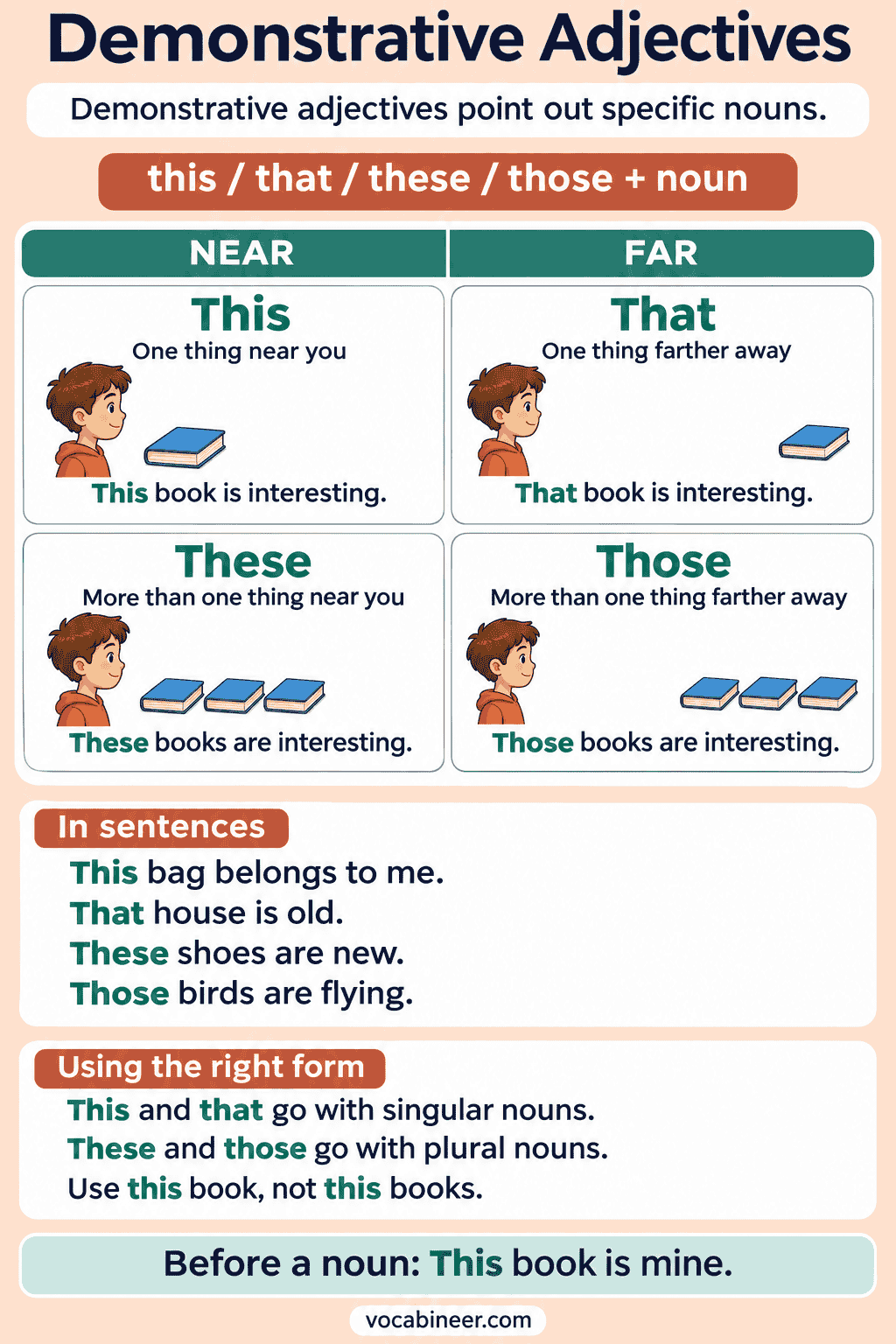
English has four demonstrative adjectives: this, that, these, and those. Choose a form based on whether the noun is singular or plural and how the speaker views its distance or context. This guide explains the forms, shows how to use them, and compares demonstrative adjectives with related words.
In This Page
Common Demonstrative Adjectives and Their Uses
A demonstrative adjective comes before a noun and identifies it. It answers which one? or which ones?
- This chair is comfortable.
- That building is very old.
- These apples taste sweet.
- Those shoes look new.
A demonstrative can also appear before numbers and other describing words: those three beautiful paintings.
In modern grammar, these words are often called demonstrative determiners when they come before nouns. Many traditional grammar books use the term demonstrative adjectives. Both labels describe the same use in examples such as this book and those flowers.
The Four Demonstrative Adjectives
Use this and these for things viewed as near, current, or connected to the speaker. Use that and those for things viewed as farther away, past, or less immediate.
| Demonstrative adjective | Noun number | Typical reference | Example |
|---|---|---|---|
| This | Singular or uncountable | Near or current | This key opens the door. |
| That | Singular or uncountable | Farther away or less immediate | That tree is tall. |
| These | Plural | Near or current | These cookies are fresh. |
| Those | Plural | Farther away or less immediate | Those lights look bright. |
Distance is a useful guide, but it is not always physical. Speakers also use demonstratives to refer to time, ideas, or information.
How to Choose the Correct Form
Match the Noun’s Number
Use this and that with singular or uncountable nouns. Use these and those with plural nouns.
| Singular or uncountable | Plural |
|---|---|
| This lesson is helpful. | These lessons are helpful. |
| That chair is broken. | Those chairs are broken. |
| This information is useful. | These facts are useful. |
| That furniture looks expensive. | Those tables look expensive. |
Avoid mismatching the demonstrative and noun:
- Correct: These books are mine.
- Incorrect: This books are mine.
- Correct: That house is empty.
- Incorrect: Those house is empty.
Use Distance and Context
The speaker’s point of view determines whether something feels near or far.
- This cup beside me is clean; that cup across the room is yours.
- These flowers in my hand smell lovely; those flowers by the gate need water.
Demonstratives can also point to times or ideas:
- This morning was unusually cold.
- That afternoon changed our plans.
- These days, many people work remotely.
- I understand your point, but that argument needs more evidence.
Expressions such as those days can refer to a period in the past: “We often played outside in those days.”
Use Demonstratives With Uncountable Nouns
Uncountable nouns take singular demonstratives: this or that.
- This advice helped me.
- That weather is unusual for April.
- This equipment belongs to the school.
- That news surprised everyone.
Do not add a plural demonstrative directly before an uncountable noun. For example, say this information, not these information. To refer to separate pieces, use a countable noun: these details or those pieces of information.
Demonstratives Before Other Describing Words
A demonstrative can come before adjectives and numbers that describe the noun.
- These three small boxes belong to the library.
- That beautiful old house stands near the river.
- Those bright red flowers need more sunlight.
The demonstrative identifies which noun the speaker means; the other words add details.
Demonstrative Adjectives and Demonstrative Pronouns
The same words—this, that, these, and those—can function as demonstrative adjectives or demonstrative pronouns. The difference is whether a noun follows.
| Function | Pattern | Example |
|---|---|---|
| Demonstrative adjective or determiner | Demonstrative + noun | This jacket is warm. |
| Demonstrative pronoun | Demonstrative stands alone | This is warm. |
More examples:
- Adjective: Those paintings are beautiful.
- Pronoun: Those are beautiful.
- Adjective: That answer is correct.
- Pronoun: That is correct.
When a noun follows the demonstrative, it identifies that noun. When the demonstrative stands in for a noun or noun phrase, it functions as a pronoun.
Demonstratives With “One” and “Ones”
The words one and ones can stand in for a noun that is already clear from context.
- I like this one better.
- Please take those ones from the shelf.
In many contexts, speakers can omit ones after these or those: “Please take those from the shelf.” The best choice depends on the sentence and the style of English being used.
Demonstrative Adjectives and Possessive Adjectives
Demonstrative adjectives identify which noun someone means. Possessive adjectives show who or what the noun belongs to or is associated with.
| Demonstrative adjective | Possessive adjective |
|---|---|
| That book is interesting. | My book is interesting. |
| These bags are heavy. | Their bags are heavy. |
| Those seats are reserved. | Our seats are reserved. |
Demonstratives in Conversation
Demonstratives also appear in common conversational patterns. On the phone, a speaker may say:
- This is Lina. (identifying herself)
- Is that Omar? (asking who is on the line)
In speech, stress can add emphasis or show a strong preference:
- I don’t want that one.
- This is exactly what I needed.
The words still point to a person, thing, or choice; intonation adds the speaker’s attitude.
Common Mistakes With Demonstrative Adjectives
Mismatching the Demonstrative and Noun
Check whether the noun is singular, plural, or uncountable.
- Correct: This lesson is helpful.
- Incorrect: These lesson is helpful.
- Correct: Those chairs are broken.
- Incorrect: That chairs are broken.
- Correct: This advice is useful.
- Incorrect: These advice is useful.
Leaving the Reference Unclear
Readers should be able to tell what this or that refers to. If the reference could be confusing, repeat the noun or name the idea.
- Unclear: The schedule changed twice. This caused confusion.
- Clearer: The schedule changed twice. This change caused confusion.
Mistaking an Adjective for a Pronoun
A demonstrative adjective comes before a noun; a demonstrative pronoun stands alone. Both uses are correct, but they have different roles.
- Adjective: Those shoes are new.
- Pronoun: Those are new.
Confusing “That” With “That’s”
That can identify a noun, while that’s is a contraction for that is or that has.
- That book is mine.
- That’s the book I wanted. (That is the book I wanted.)
Frequently Asked Questions
The four forms are this, that, these, and those. They identify specific nouns.
Use this for a singular or uncountable noun viewed as near or current. Use that for one viewed as farther away or less immediate.
Use these with plural nouns viewed as near or current. Use those with plural nouns viewed as farther away or less immediate.
Yes. Examples include this morning, those days, and that idea. The words point to a time or idea rather than a nearby object.
Look for a noun after the demonstrative. In those shoes, those is a demonstrative adjective or determiner. In those are new, it is a demonstrative pronoun.
Conclusion
This, that, these, and those identify specific nouns. Match this and that with singular or uncountable nouns, and these and those with plural nouns. Use context to decide whether something feels near or far. When a demonstrative stands alone instead of coming before a noun, it functions as a pronoun.
Read More