

A road can be wide, wider than another road, or the widest in a neighborhood. These forms show three different ways to express the same quality: describe it, compare it, or rank it within a group.
These forms are called the degrees of comparison. English uses positive, comparative, and superlative forms with many adjectives and adverbs. Their spelling and structure depend on the word and the kind of comparison. This guide explains the main rules, irregular forms, examples, and common mistakes.
In This Page
What Are Degrees of Comparison?
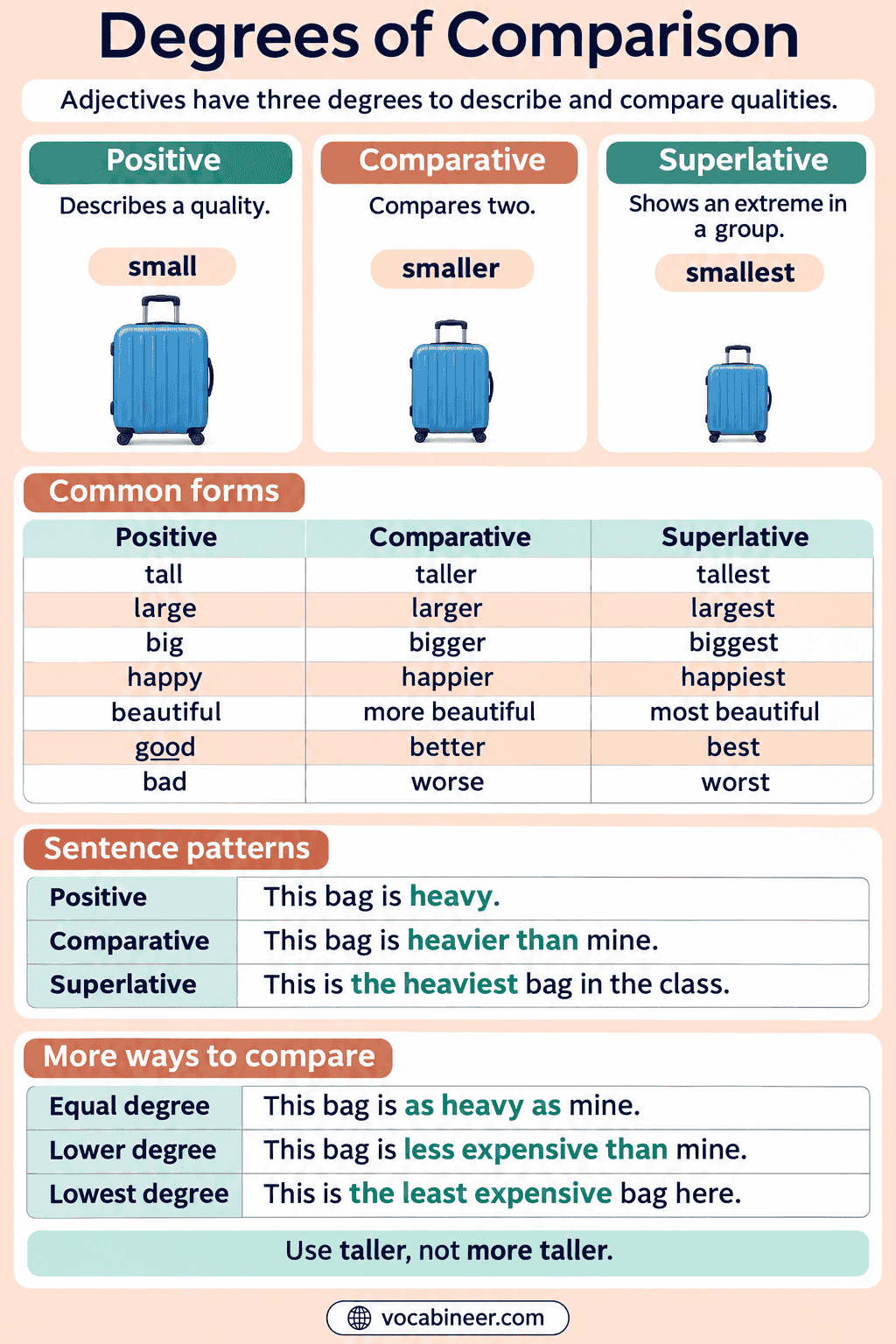
Degrees of comparison show how strongly a quality applies or how it compares with another. The positive degree states a quality; the comparative compares; the superlative identifies the highest or lowest degree within a group.
| Degree | Function | Example |
|---|---|---|
| Positive | States a quality without ranking it | The road is wide. |
| Comparative | Compares two items | This road is wider than that one. |
| Superlative | Ranks an item within a group | It is the widest road in town. |
Here, positive means the adjective’s basic form. It does not mean the quality is favorable.
Positive Degree
The positive degree is the basic form of an adjective or adverb. Use it to describe something without ranking it against another item.
- The room is bright.
- She spoke clearly.
- This bag is as light as that one.
To show that one item has a lower degree of a quality, use not as … as or not so … as:
This path is not as steep as the one by the river.
This pattern uses the positive form of the adjective, not its comparative form. Say as fast as, not as faster as.
Comparative Degree
Use the comparative degree to compare the quality or action of two people, things, places, or groups.
- My new desk is larger than my old one.
- This puzzle is more difficult than the last one.
- The side street is less crowded than the main road.
Common comparative patterns
| Pattern | Use | Example |
|---|---|---|
| adjective/adverb + -er + than | Compare many short words | A train is faster than a bus. |
| more + adjective/adverb + than | Compare many longer words | She explained it more clearly than I did. |
| less + adjective/adverb + than | Show a lower degree | This route is less convenient than the other one. |
| as + basic form + as | Show equal degree | The blue bag is as light as the red one. |
| not as/so + basic form + as | Show unequal degree | This chair is not as comfortable as that one. |
Use than when you name the second item in an unequal comparison. You can omit it if the comparison is clear from context:
The weather is getting warmer.
Modifying comparatives
Words such as much, far, a lot, slightly, and a little can show the size of a difference:
- This route is much shorter than the highway.
- The second question is a little harder.
- She arrived slightly earlier than we expected.
- The new model is far more efficient.
Do not use very directly before a comparative. Say much better, not very better.
Superlative Degree
Use the superlative degree to identify the highest or lowest degree of a quality within a group. The group can include people, objects, places, or experiences.
- It was the coldest day of the year.
- This is the most comfortable seat in the room.
- That was the least expensive option.
A group is often introduced with in or of:
- She is the fastest runner in the class.
- He chose the largest of the three boxes.
The structure one of the + superlative + plural noun identifies one member of a top-ranked group:
This is one of the most popular books in the series.
Use a plural noun after one of the: one of the best books, not one of the best book.
Superlatives usually take the, but another determiner can replace it:
- the best answer
- my best result
- her most useful idea
Forming Comparatives and Superlatives
The form depends on the adjective or adverb. These are the most common spelling patterns:
| Word pattern | Comparative | Superlative | Example |
|---|---|---|---|
| Most short words | Add -er / -est | Add -er / -est | fast → faster → fastest |
| Final silent e | Add -r / -st | Add -r / -st | wide → wider → widest |
| Consonant + y | Change y to i, then add -er | Change y to i, then add -est | happy → happier → happiest |
| Short vowel + final consonant | Usually double the final consonant and add -er | Usually double it and add -est | hot → hotter → hottest |
| Many longer words | Use more | Use most | careful → more careful → most careful |
| Lower degree | Use less | Use least | useful → less useful → least useful |
Short adjectives
Many one-syllable adjectives take -er and -est:
- small → smaller → smallest
- bright → brighter → brightest
- quick → quicker → quickest
Adjectives ending in e
If an adjective ends in silent e, add -r for the comparative and -st for the superlative:
- large → larger → largest
- nice → nicer → nicest
Adjectives ending in consonant + y
Change y to i before adding the ending:
- easy → easier → easiest
- busy → busier → busiest
Short vowel + final consonant
Many short adjectives with a single vowel followed by a consonant double the final consonant:
- big → bigger → biggest
- thin → thinner → thinnest
This spelling pattern depends on the word’s form and pronunciation. Therefore, check an unfamiliar adjective in a dictionary.
Longer adjectives
Many adjectives with two or more syllables use more and most:
- careful → more careful → most careful
- important → more important → most important
- comfortable → more comfortable → most comfortable
Some two-syllable adjectives allow more than one pattern. For instance, both quieter and more quiet occur, though one may sound more natural in a particular context or variety of English.
Irregular Forms
Some common words do not follow the usual spelling patterns. Learn these forms individually:
| Positive | Comparative | Superlative |
|---|---|---|
| good | better | best |
| well | better | best |
| bad | worse | worst |
| badly | worse | worst |
| far | farther/further | farthest/furthest |
| little | less | least |
| many/much | more | most |
Good is an adjective: “This is a good plan.” Well is usually an adverb: “She sings well.” Both use better and best in their comparison forms.
Farther often refers to physical distance: “The next station is farther away.” Further can refer to distance or additional extent: “For further information, ask the guide.” In everyday English, the two words sometimes overlap when talking about distance.
Degrees of Comparison for Adverbs
Adverbs describe verbs, adjectives, or other adverbs. Many adverbs form comparisons in ways similar to adjectives.
| Positive | Comparative | Superlative |
|---|---|---|
| fast | faster | fastest |
| hard | harder | hardest |
| carefully | more carefully | most carefully |
| clearly | more clearly | most clearly |
| well | better | best |
| badly | worse | worst |
Use -er/-est with some short adverbs:
- The cyclist moved faster than before.
- Of the three runners, Nia finished fastest.
Many adverbs ending in -ly use more and most:
- He listened more carefully this time.
- She spoke the most clearly during the presentation.
Avoid confusing an adjective with an adverb. An adjective describes a noun; an adverb usually describes how an action happens:
- Correct: She is a careful driver.
- Correct: She drives carefully.
- Incorrect for this meaning: She drives careful.
Choosing the Right Comparison Pattern
Use the pattern that matches the meaning you want to express.
| Meaning | Pattern | Example |
|---|---|---|
| State a quality | Positive form | The classroom is quiet. |
| Compare two items | Comparative + than | This classroom is quieter than the hall. |
| Show equal degree | as + positive form + as | The hall is as quiet as the library. |
| Show a lower degree | less + positive form + than | The hall is less quiet than the library. |
| Rank within a group | the + superlative | It is the quietest room in the building. |
In standard learner grammar, use a comparative for a direct comparison between two items and a superlative to rank one item within a group. Everyday usage can vary, but this is a dependable rule for clear writing.
Common Mistakes with Degrees of Comparison
| Incorrect | Correct | Explanation |
|---|---|---|
| This road is more wider. | This road is wider. | Do not combine more with an -er form. |
| It is the most easiest question. | It is the easiest question. | Do not combine most with an -est form. |
| She is taller as her sister. | She is taller than her sister. | Use than for an unequal comparison. |
| This is the most tallest building. | This is the tallest building. | Avoid double superlative marking. |
| One of the best book in the series | One of the best books in the series | Use a plural noun after one of the. |
| She sings beautiful. | She sings beautifully. | Use an adverb to describe how she sings. |
| This is my the best result. | This is my best result. | Do not normally use the with a possessive determiner. |
Keep the comparison targets logically parallel. For example, compare a car with another car, rather than saying, “This car is faster than the bus’s engine.” A clear comparison names the same kind of thing on both sides.
Degrees of Comparison in Sentences
The following examples show positive, comparative, and superlative forms in familiar situations:
| Context | Positive | Comparative | Superlative |
|---|---|---|---|
| People | Lina is young. | Lina is younger than her brother. | Lina is the youngest person in her family. |
| Places | The lane is narrow. | This lane is narrower than the next one. | It is the narrowest lane in the neighborhood. |
| School | The test is difficult. | The second test is more difficult than the first. | The final test was the most difficult of all. |
| Food | The soup is spicy. | This soup is spicier than yesterday’s. | It is the spiciest dish on the menu. |
| Weather | Today is cold. | Today is colder than yesterday. | This is the coldest week of the winter. |
| Objects | The blue bag is light. | The blue bag is lighter than the black one. | It is the lightest bag in the shop. |
Here are a few additional patterns:
- The red sofa is as comfortable as the gray one.
- This route is less crowded than the main road.
- Of the three recipes, this one is the easiest to prepare.
- She completed the task more carefully than her partner.
- He is one of the best players on the team.
- Your answer is much clearer now.
Frequently Asked Questions
The three degrees are positive, comparative, and superlative. The positive form states a quality, the comparative compares two items, and the superlative ranks an item within a group.
Many short adjectives take -er, as in faster. Many longer adjectives use more, as in more comfortable. Some two-syllable adjectives allow either pattern, so choose the form that sounds natural and is commonly used.
Use than when you state the second item: “This bag is lighter than that one.” You can leave it out when the comparison is clear: “This bag is getting lighter.”
Superlatives commonly use the, as in “the fastest runner.” A possessive or another determiner may replace it: “my fastest time” or “her best idea.”
Many adverbs do. For example, carefully becomes more carefully and most carefully, while fast becomes faster and fastest. Some adverbs have irregular forms, such as well, better, best.
Conclusion
The positive degree states a quality, the comparative degree compares, and the superlative degree ranks an item within a group. Use -er/-est with many short words and more/most with many longer ones; also remember irregular forms such as good, better, best. The same basic idea applies to many adverbs: wide, wider, widest and carefully, more carefully, most carefully.
Read More