

Possessive adjectives show who owns something or who something is connected to. In “Maya found her keys,” the word her tells us whose keys they are.
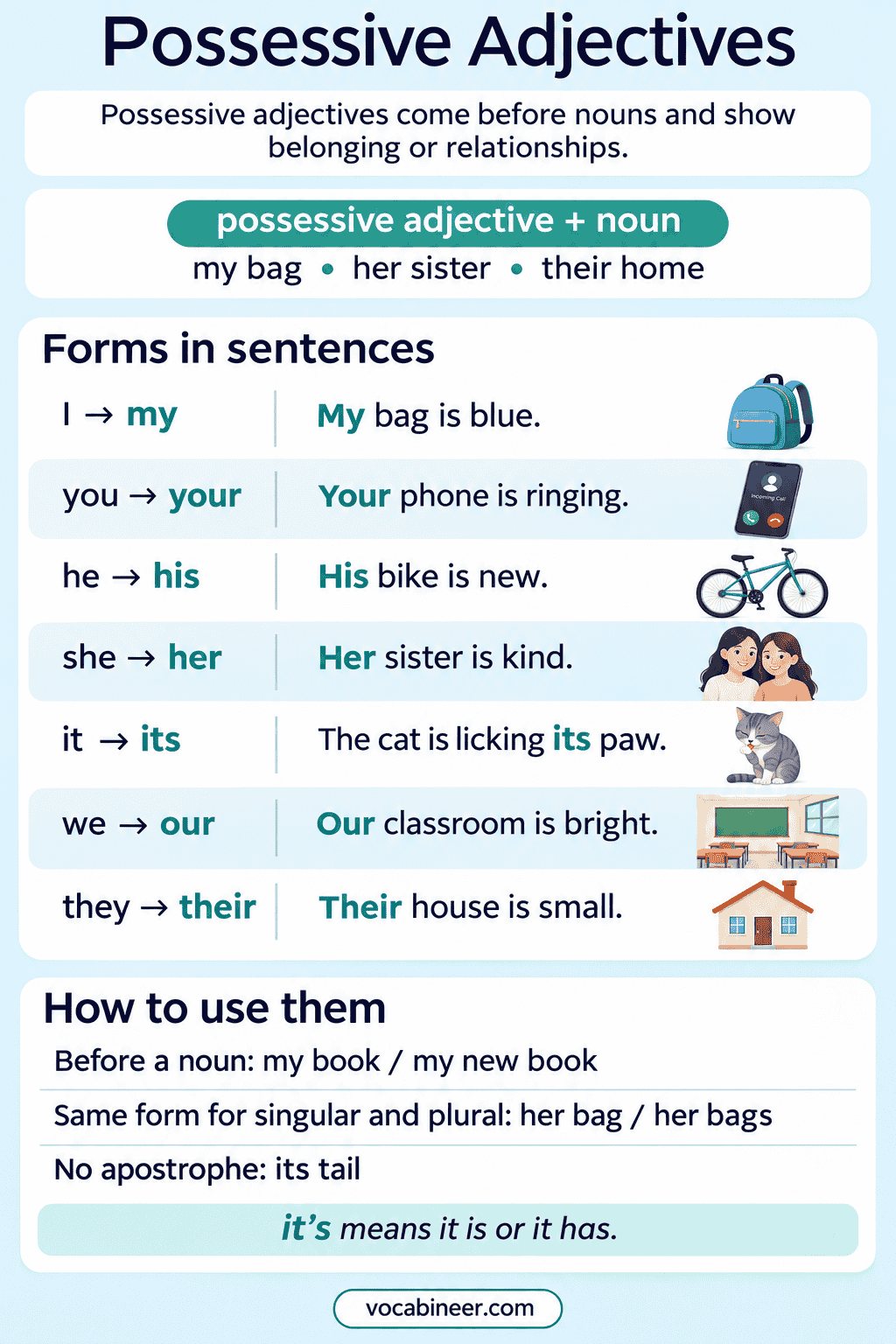
The seven possessive adjectives are my, your, his, her, its, our, and their. Each comes before a noun, helping readers identify the person or thing associated with it. This guide explains how to use them, how they differ from possessive pronouns, and how to avoid common mistakes.
In This Page
What Are Possessive Adjectives?
A possessive adjective is a word placed before a noun to show possession, relationship, or association. In modern grammar, these words are also called possessive determiners because they determine which person or thing the noun refers to.
- My coat is on the chair.
- We visited their house.
- The dog wagged its tail.
In each example, the possessive adjective appears directly before a noun: coat, house, or tail.
List of Possessive Adjectives
The possessive adjective depends on the person or thing associated with the noun. It does not change according to whether the noun is singular or plural.
| Possessive adjective | Refers to | Example |
|---|---|---|
| My | The speaker | I forgot my notebook. |
| Your | The person or people being addressed | Is this your seat? |
| His | A male person or animal | Daniel brought his lunch. |
| Her | A female person or animal | Leila finished her project. |
| Its | A thing, organization, or animal when gender is unknown or irrelevant | The bird returned to its nest. |
| Our | The speaker and at least one other person | We shared our snacks. |
| Their | The people or things being discussed | The players wore their uniforms. |
Your Can Refer to One Person or Several
Your is used for both a singular and a plural you. The surrounding sentence makes the meaning clear.
- Is this your jacket? (one person)
- Please open your books to page ten. (several people)
Their Can Refer to One Person
Their can refer to more than one person, but it is also widely used as a singular, gender-neutral pronoun when a person’s gender is unknown, irrelevant, or when that person uses they/them pronouns.
- Someone left their umbrella.
- Alex brought their lunch.
How to Use Possessive Adjectives
Put the Possessive Adjective Before a Noun
A possessive adjective must accompany a noun, though other describing words may come between them.
- Her bicycle is new.
- We admired their beautifully decorated garden.
- He packed his two small bags.
The possessive adjective identifies the noun; it does not replace it.
Show Ownership or Association
Possessive adjectives can refer to ownership, but they also show relationships and other connections.
- Ownership: I charged my phone.
- Family relationship: She called her brother.
- Part of something: The tree lost its leaves.
- Group connection: The school changed its schedule.
- Shared experience: We enjoyed our trip.
The noun does not always belong legally to the person named. The adjective may simply show a connection.
Match the Person, Not the Noun
A possessive adjective refers to the person or thing connected to the noun. It does not change to match the noun that follows it.
- My book and my books
- Her car and her cars
- Their room and their rooms
The noun can be singular or plural while the possessive adjective stays the same.
Possessive Adjectives and Possessive Pronouns
Possessive adjectives come before nouns. Possessive pronouns stand alone and replace a noun phrase.
| Possessive adjective | Example | Possessive pronoun | Example |
|---|---|---|---|
| My | This is my cup. | Mine | This cup is mine. |
| Your | Is that your coat? | Yours | That coat is yours. |
| His | We found his keys. | His | The keys are his. |
| Her | I borrowed her pen. | Hers | The pen is hers. |
| Our | This is our table. | Ours | The table is ours. |
| Their | They brought their equipment. | Theirs | The equipment is theirs. |
Notice that his has the same form as both a possessive adjective and a possessive pronoun. Its role depends on how it is used:
- Possessive adjective: That is his jacket.
- Possessive pronoun: That jacket is his.
English does not commonly use its as a standalone possessive pronoun. Use its before a noun: “The company changed its name.”
Possessive Adjectives and Possessive Nouns
Possessive adjectives are different from possessive nouns, which usually show possession with an apostrophe.
- Possessive adjective: This is her bicycle.
- Possessive noun: This is Maya’s bicycle.
A possessive adjective does not take an apostrophe. The apostrophe belongs to forms such as Maya’s, the children’s, and the teachers’.
Common Mistakes with Possessive Adjectives
Confusing Its and It’s
Its is a possessive adjective. It’s is a contraction meaning it is or it has.
- The cat cleaned its paws.
- It’s raining outside. (It is raining.)
To check, try replacing the word with it is. If the sentence still works, use it’s. Otherwise, the possessive form is usually its.
Using an Apostrophe in His, Hers, Ours, or Theirs
Possessive adjectives and pronouns do not use apostrophes.
- Correct: their house
- Incorrect: their’s house
- Correct: The seat is hers.
- Incorrect: The seat is her’s.
Using a Possessive Adjective Without a Noun
Possessive adjectives usually need a noun after them.
- Correct: This is my bag.
- Incorrect: This bag is my.
Use the possessive pronoun mine when the noun is not repeated: “This bag is mine.”
Choosing the Form Based on the Noun
The possessive adjective refers to the owner or associated person, not the noun that follows.
- Correct: Maria brought her books.
- Incorrect: Maria brought their books. (if Maria is the only person intended and does not use they/them pronouns)
Use the pronouns that fit the person or people being discussed.
Confusing Her With She
Her can function as a possessive adjective before a noun or as an object pronoun after a verb or preposition.
- Possessive adjective: I found her phone.
- Object pronoun: I called her.
Use she as a subject pronoun: “She found the phone.”
Frequently Asked Questions
The seven possessive adjectives are my, your, his, her, its, our, and their.
No. The possessive adjective stays the same whether the noun is singular or plural: my book, my books.
Yes. Their can refer to one person when that person’s gender is unknown or when the person uses they/them pronouns. For example: “Jordan forgot their keys.”
Its shows possession and comes before a noun, as in “The bird spread its wings.” It’s means it is or it has, as in “It’s getting late.”
No. A possessive adjective comes before a noun: “That is your seat.” To replace the noun, use a possessive pronoun: “That seat is yours.”
Conclusion
Possessive adjectives—my, your, his, her, its, our, and their—come before nouns to show ownership or association. Remember to choose the form based on who the noun is connected to, distinguish possessive adjectives from pronouns, and use its and it’s correctly.
Read More