

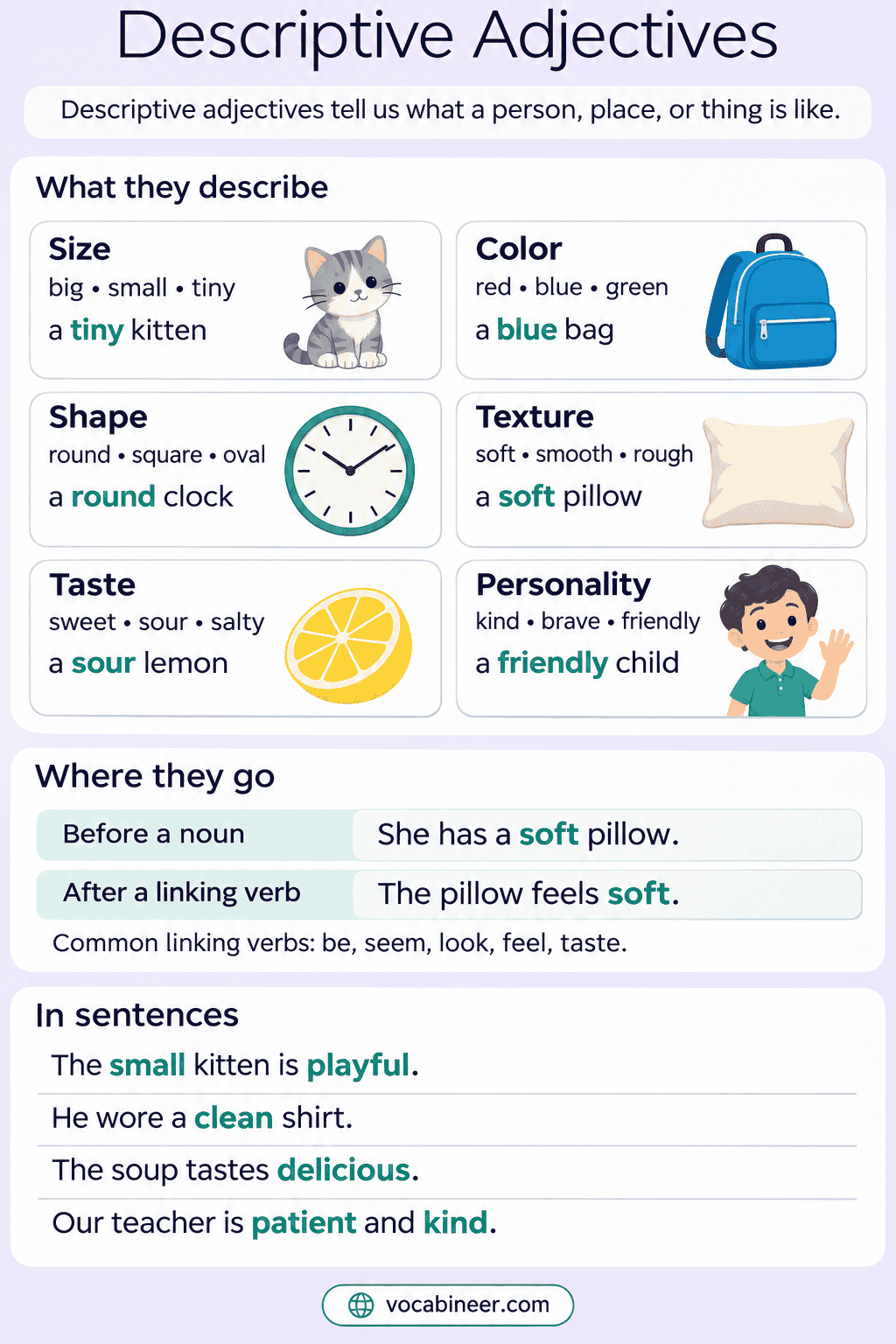
Descriptive adjectives tell readers what a person, place, thing, or idea is like. In “a quiet street,” quiet describes the street and helps readers picture it.
Descriptive adjectives can express color, size, shape, age, appearance, personality, emotion, taste, sound, texture, or condition. They appear before nouns, as in a cheerful child, or after linking verbs, as in the child seems cheerful. This guide explains their forms and uses, how they differ from related words, and how to use them clearly.
In This Page
What Descriptive Adjectives Do
A descriptive adjective gives a quality or characteristic of a noun or pronoun. It answers questions such as What is it like? and What kind of person, place, or thing is it?
- We entered a bright room.
- The soup tastes spicy.
- She seems confident.
- They heard a strange noise.
Descriptive adjectives add useful detail. For example, “a small blue cup” tells readers more than “a cup.”
Common Types of Descriptive Adjectives
Descriptive adjectives describe many kinds of qualities. These categories help organize examples, although one adjective may fit more than one category.
| Quality | Examples | Example phrase |
|---|---|---|
| Size | large, tiny, narrow | a tiny seed |
| Color | green, golden, pale | a golden scarf |
| Shape | round, curved, flat | a curved path |
| Age | young, old, modern | an old bridge |
| Appearance | beautiful, neat, spotless | a neat desk |
| Personality | patient, honest, cheerful | an honest friend |
| Emotion or condition | nervous, sleepy, excited | an excited child |
| Taste or smell | sweet, bitter, fragrant | a fragrant flower |
| Sound or texture | quiet, rough, smooth | a smooth surface |
| Evaluation | useful, difficult, excellent | a useful guide |
Where Descriptive Adjectives Appear
Before a Noun: Attributive Adjectives
When an adjective appears before the noun it describes, it has an attributive position.
- They bought a comfortable sofa.
- We watched a colorful parade.
- He carried a heavy box.
Several adjectives can appear before one noun, but use only the details readers need: “a beautiful old Italian table” is clearer than a long string of similar descriptions.
After a Linking Verb: Predicate Adjectives
When an adjective follows a linking verb and describes the subject, it has a predicate position. Common linking verbs include be, seem, look, feel, sound, taste, and smell.
- The soup tastes spicy.
- The children seem tired.
- This fabric feels soft.
- The sky is cloudy.
The adjective describes the subject; it does not receive an action. For example, soft describes fabric in “The fabric feels soft.”
After a Noun in Certain Expressions
Some adjectives follow the noun, especially in fixed or formal expressions.
- the people responsible
- a court martial
- something useful
In everyday sentences, however, descriptive adjectives usually appear before nouns or after linking verbs.
Adjective Order and Commas
When several adjectives describe one noun, English speakers tend to follow a familiar order:
Opinion → size → age → shape → color → origin → material → purpose → noun
For instance, speakers might say a beautiful small old wooden box. The order is a guide, not a strict formula, and long strings of adjectives often sound unnatural. Use the ones that clarify the noun.
Use a comma between coordinate adjectives—adjectives that independently describe the noun and can often be joined by and.
- a cold, rainy day
(a cold and rainy day)
Do not usually use a comma between adjectives that work together as a unit or follow a conventional order.
- two large glass jars
(not usually “large and glass jars”)
A helpful test: if and fits naturally between the adjectives and their order can be reversed, a comma is often appropriate.
Participles Used as Descriptive Adjectives
Present and past participles can function as descriptive adjectives.
- The glowing lamp lit the room.
- The broken window needs repair.
- We heard an alarming noise.
- The audience looked alarmed.
Often, an -ing adjective describes what causes a feeling, while an -ed adjective describes the person or thing experiencing it.
| -ing adjective: causes a feeling | -ed adjective: experiences a feeling |
|---|---|
| The film was boring. | I was bored. |
| The news was surprising. | We were surprised. |
| The task was tiring. | She felt tired. |
Compare the meaning in these examples:
- A concerned parent feels worry.
- A concerning report causes worry.
This pattern is common, although not every participial adjective follows it in exactly the same way.
Descriptive Adjectives and Other Word Types
Descriptive adjectives tell what something is like. Other words identify or limit a noun instead.
| Word type | Main purpose | Example |
|---|---|---|
| Descriptive adjective | Describes a quality | a soft blanket |
| Demonstrative | Points to a noun | that blanket |
| Possessive | Shows association or ownership | her blanket |
| Quantity word | Tells how much or how many | several blankets |
| Interrogative | Introduces a question about a noun | which blanket? |
Traditional grammar often groups all these words under “adjectives.” Modern grammar usually classifies words such as this, her, and several as determiners because they specify the noun rather than describe its qualities.
Also, not every word placed before a noun is an adjective. A noun can modify another noun:
- a stone wall — stone is a noun used before another noun.
- a stone house — stone still identifies the material, but it remains a noun modifier in this phrase.
- a stony path — stony is an adjective.
Adjective Complements
Some descriptive adjectives are followed by a phrase or clause that completes their meaning.
- She is proud of her work.
- I am glad that you came.
- The team is ready to begin.
- He was afraid of the dark.
The phrases of her work, that you came, to begin, and of the dark add information about the adjectives.
Degrees of Descriptive Adjectives
Descriptive adjectives can appear in positive, comparative, and superlative forms. The comparative compares two things; the superlative identifies the highest or lowest degree in a group.
| Degree | Purpose | Example |
|---|---|---|
| Positive | Describes without comparison | This path is narrow. |
| Comparative | Compares two things | This path is narrower than the other one. |
| Superlative | Compares three or more | This is the narrowest path in the park. |
Short adjectives often take -er and -est: small, smaller, smallest. Longer adjectives commonly use more and most: careful, more careful, most careful. Some forms are irregular: good, better, best.
Some adjectives describe qualities that are not usually treated as having degrees. For example, unique means one of a kind, so very unique may sound illogical in formal writing. In everyday speech, however, speakers sometimes use degree words with adjectives such as unique or perfect for emphasis.
Avoid double comparisons:
- Correct: This puzzle is more difficult.
- Incorrect: This puzzle is more difficulter.
- Correct: It is the brightest room.
- Incorrect: It is the most brightest room.
Descriptive Adjectives and Adverbs
An adjective describes a noun or pronoun. An adverb usually describes a verb, an adjective, or another adverb.
- Adjective: She has a beautiful voice.
- Adverb: She sings beautifully.
- Adjective: He is a careful driver.
- Adverb: He drives carefully.
After a linking verb, use an adjective when it describes the subject: “The bread smells fresh.” An adverb can follow an action verb when it describes how an action happens: “The baker smelled the bread carefully.”
Using Descriptive Adjectives Clearly
Choose adjectives that add specific, relevant information. A precise word often works better than several vague or repetitive ones.
- Wordy: She wore a nice, pretty, beautiful dress.
- Clearer: She wore a blue silk dress.
Also consider tone and context. For instance, slim may sound more positive than thin in some situations, while thin may be more neutral or accurate. Choose the word that expresses your intended meaning.
Common Mistakes With Descriptive Adjectives
Using an Adverb Instead of an Adjective
Use an adjective to describe a noun and an adverb to describe an action.
- Correct: The singer has a beautiful voice.
- Incorrect: The singer has a beautifully voice.
- Correct: The singer sings beautifully.
Using an Adverb After a Linking Verb
When a linking verb connects the subject to a description, use an adjective.
- Correct: The bread smells fresh.
- Incorrect: The bread smells freshly.
(This suggests the bread performs the action of smelling in a fresh manner.)
Forming Double Comparisons
Do not combine more or most with an adjective that already has -er or -est.
- Correct: This puzzle is more difficult.
- Incorrect: This puzzle is more difficulter.
- Correct: It is the brightest room.
- Incorrect: It is the most brightest room.
Stacking Too Many Adjectives
Long strings of similar adjectives can hide the main point.
- Overloaded: We entered a large, spacious, huge, enormous hall.
- Clearer: We entered an enormous hall.
Frequently Asked Questions
A descriptive adjective tells what a person, place, thing, or idea is like. In “a quiet room,” quiet describes the room.
Examples include bright, narrow, green, cheerful, rough, fragrant, and useful. They describe qualities such as color, size, mood, texture, smell, or value.
Yes. A predicate adjective follows a linking verb and describes the subject: “The room looks tidy” and “The tea tastes sweet.”
Yes. In “a glowing lamp” and “a broken window,” participles describe nouns.
A descriptive adjective describes a noun or pronoun, as in “a careful driver.” An adverb usually describes an action, as in “She drives carefully.”
Conclusion
Descriptive adjectives add detail about nouns and pronouns, including qualities such as color, size, appearance, emotion, and texture. They can appear before a noun or after a linking verb. Use precise words, follow natural adjective order, and form comparisons correctly to keep descriptions clear.
Read More