

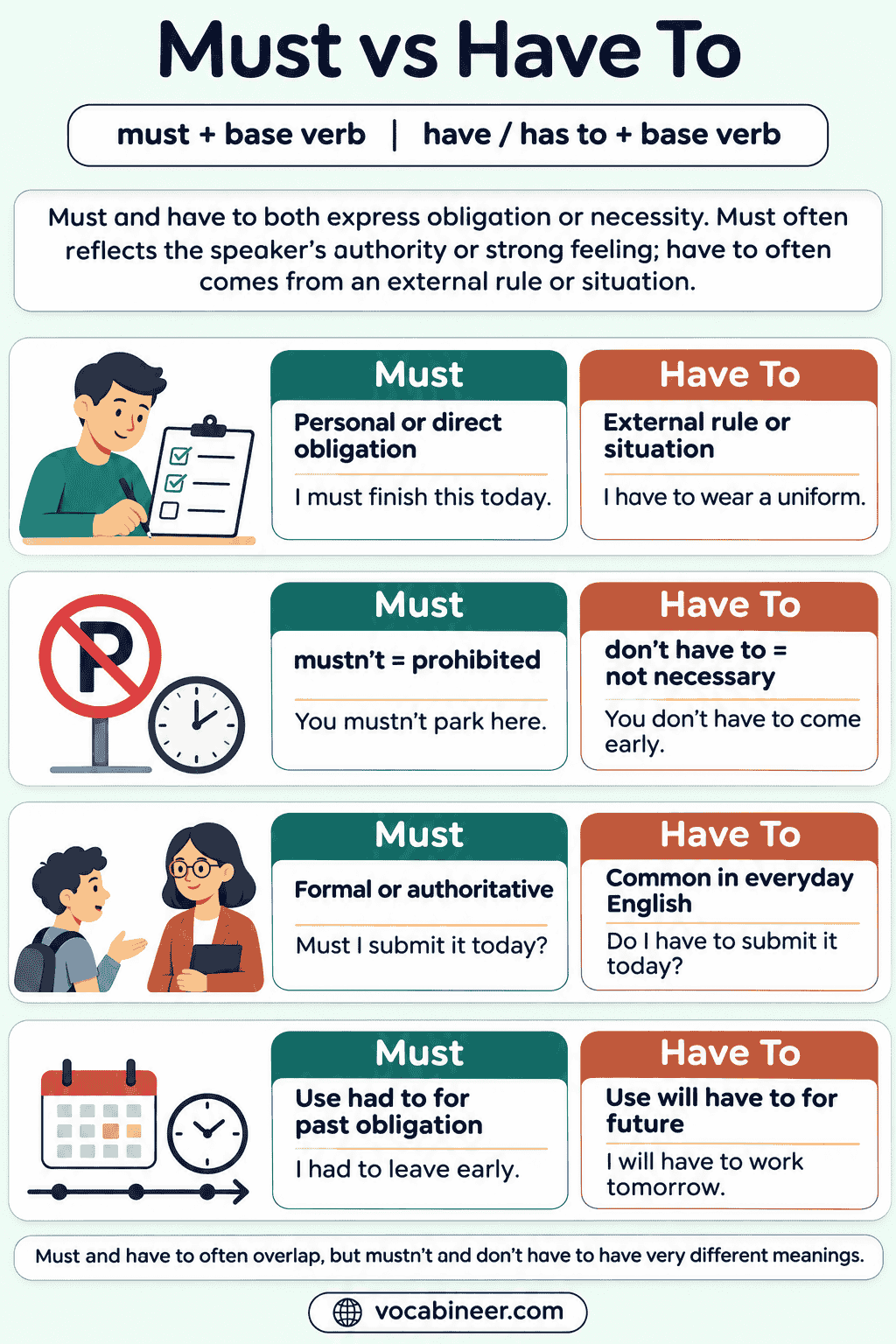
Must and have to both express obligation or necessity. For example, “You must wear a seat belt” and “You have to wear a seat belt” both describe something necessary. Although their meanings often overlap, the two forms do not always work in the same way.
The main differences involve grammar, tone, time, and negative meaning. Must often sounds direct, personal, or authoritative, whereas have to commonly describes a requirement created by rules or circumstances. However, this distinction is not absolute. This guide explains how to choose between must and have to in statements, negatives, questions, different tenses, deductions, and everyday expressions.
In This Page
Must and Have To at a Glance
The following table summarizes the main differences.
| Point | Must | Have to |
|---|---|---|
| Main meaning | Strong obligation, necessity, or instruction | Obligation or practical necessity |
| Typical source | Often the speaker or an authority | Often a rule, duty, or circumstance |
| Grammar | Modal verb | Semi-modal expression |
| Subject agreement | Never changes | Changes to has to with he, she, and it |
| Past obligation | Usually changes to had to | Changes to had to |
| Future necessity | Can refer to the future; will have to is often used | Usually will have to |
| Negative meaning | Must not expresses prohibition | Do not have to expresses no necessity |
| Questions | Must I…? | Do I have to…? |
| Everyday conversation | Less common for ordinary obligations | Very common |
| Logical deduction | Common | Possible, especially in informal English |
The speaker-versus-external-obligation distinction is a helpful starting point, but it is not a strict rule. In everyday English, speakers often use have to for both personal and external obligations.
Sentence Structures
Must behaves like a modal verb, so it is followed directly by the base form. It does not take -s with third-person singular subjects. By contrast, have to changes according to the subject and tense.
| Sentence type | Must | Have to |
|---|---|---|
| Affirmative | Subject + must + base verb | Subject + have/has to + base verb |
| Negative | Subject + must not + base verb | Subject + do/does not have to + base verb |
| Question | Must + subject + base verb? | Do/Does + subject + have to + base verb? |
| Past | Subject + had to + base verb | Subject + had to + base verb |
| Future | Subject + will have to + base verb | Subject + will have to + base verb |
Examples:
- I must finish this work.
- She must finish this work.
- I have to finish this work.
- She has to finish this work.
- You must not enter.
- We do not have to wait.
- Must I attend the meeting?
- Does he have to wear a uniform?
Do not add to after must. The correct form is must leave, not must to leave.
Strong Obligations with Must
Personal Responsibility
Use must when you consider an action personally important or necessary.
- I must call my parents tonight.
- We must remember the deadline.
- I must exercise more regularly.
The obligation comes from the speaker’s own judgment rather than an external rule.
Firm Instructions
Use must when giving a strong instruction.
- You must submit the form today.
- Students must remain silent during the test.
- You must follow the safety instructions.
Because must can sound forceful, it may seem too direct in sensitive conversations. A softer expression such as need to may be more suitable in those situations.
Rules and Formal Requirements
Notices, policies, and official instructions often use must.
- Passengers must wear seat belts.
- Applicants must provide identification.
- Visitors must report to reception.
In formal instructions, must clearly marks a mandatory requirement. However, its exact legal effect depends on the document and the drafting system.
Urgent Necessity
Must can emphasize that an action cannot reasonably be delayed.
- We must leave immediately.
- You must seek medical help.
- The leak must be repaired before the building reopens.
Strong Recommendations
Sometimes must expresses enthusiasm rather than an actual obligation.
- You must try this dessert.
- You must visit the old city.
- You must watch that documentary.
Context shows whether must communicates a rule, urgent necessity, or strong recommendation.
Practical Necessity with Have To
Rules and Requirements
Have to commonly describes obligations imposed by rules or organizations.
- Employees have to wear identification cards.
- Students have to complete the assignment by Friday.
- Drivers have to stop at a red light.
Circumstances
Use have to when a situation makes an action necessary.
- I have to walk because my car is being repaired.
- She has to take the earlier train.
- We have to cancel the picnic because of the weather.
Regular Responsibilities
Have to is natural for recurring duties.
- He has to get up at six every morning.
- We have to clean the office on Fridays.
- Maya has to travel for work twice a month.
Everyday Obligations
In conversation, have to is often more natural than must, even when the obligation is personal.
- I have to buy some groceries.
- I have to finish this report tonight.
- They have to leave before noon.
Understanding the Source of an Obligation
Traditional explanations often connect must with an obligation created by the speaker and have to with an external requirement. This distinction works in many situations, but actual usage is more flexible.
| Situation | Natural choice | Example |
|---|---|---|
| The speaker feels personally responsible | Must | I must exercise more often. |
| The speaker gives a firm instruction | Must | You must return the key. |
| A rule creates the obligation | Have to | We have to show our passes. |
| Circumstances create the necessity | Have to | I have to take a taxi. |
| An everyday duty is involved | Have to | She has to attend a meeting. |
| A formal written requirement is stated | Must | Applications must arrive by Friday. |
Both forms can describe an equally strict obligation:
- You must wear a helmet.
- You have to wear a helmet.
Therefore, must is not always objectively stronger. The difference may involve tone, source, or grammatical construction rather than the seriousness of the requirement.
Must Not and Do Not Have To
The negative forms have completely different meanings.
| Form | Meaning | Example |
|---|---|---|
| must not / mustn’t | An action is prohibited | You must not touch the equipment. |
| do not have to | An action is unnecessary or optional | You do not have to attend the meeting. |
Compare these sentences:
- You must not leave early. Leaving early is prohibited.
- You do not have to leave early. Leaving early is optional; there is no necessity.
Several related negative forms also need careful distinction.
| Form | Usual meaning |
|---|---|
| must not | Strong prohibition |
| cannot | Lack of permission or possibility |
| do not have to | Absence of necessity |
| do not need to | Absence of necessity |
| need not | Absence of necessity, especially in formal or British English |
Questions and Short Answers
Questions with have to are more common in everyday English. Questions with must can sound formal, reluctant, impatient, or critical.
| Form | Typical use | Example |
|---|---|---|
| Must I…? | Formal question or concern about a requirement | Must I sign every page? |
| Do I have to…? | Neutral everyday question about necessity | Do I have to sign every page? |
| Does he have to…? | Third-person present question | Does he have to attend? |
| Did they have to…? | Past question | Did they have to wait? |
Must can also express annoyance:
- Must you make so much noise?
- Must we discuss this now?
Use the following short answers:
| Question | Affirmative answer | Negative answer |
|---|---|---|
| Must I attend? | Yes, you must. | No, you don’t have to. / No, you needn’t. |
| Do I have to attend? | Yes, you do. | No, you don’t. |
| Does she have to attend? | Yes, she does. | No, she doesn’t. |
Do not answer No, you mustn’t unless you mean that the action is prohibited.
Present, Past, and Future Forms
Unlike have to, must has no ordinary past-tense form and cannot appear in every grammatical construction.
| Time or form | Correct construction | Example |
|---|---|---|
| Present obligation | must / have to | I must leave. / I have to leave. |
| Third-person present | must / has to | She must leave. / She has to leave. |
| Past obligation | had to | We had to leave. |
| Future necessity | will have to | They will have to leave. |
| Present perfect | have/has had to | He has had to work late. |
| Past perfect | had had to | She had had to cancel before. |
| Temporary necessity | be having to | I am having to work from home. |
Past Obligation
Use had to for an obligation that existed in the past.
- I had to work last Saturday.
- She had to show her passport.
- We had to wait for two hours.
Do not use musted. That form does not exist.
Future Obligation
Must can refer to a future obligation when the time is clear:
- You must submit the form tomorrow.
However, will have to is often more natural when a future situation will create the necessity:
- We will have to cancel the trip if the weather worsens.
- She will have to renew her passport next year.
| Form | Typical meaning |
|---|---|
| must | A present decision or instruction concerning the future |
| will have to | A predicted future necessity or requirement |
Perfect and Continuous Forms
Use have had to for obligations that have occurred repeatedly or continued up to the present.
- I have had to change my schedule several times.
- She has had to work late all week.
Had had to is grammatical when one past obligation occurred before another past event, although it can sound awkward.
- By the time the project ended, we had had to revise the plan three times.
The progressive form emphasizes a temporary or developing necessity.
- We are having to reduce our expenses.
- I am having to travel more often this month.
Formal and Informal Usage
| Context | More natural choice |
|---|---|
| Formal rules and notices | Must |
| Official requirements | Must or have to |
| Everyday conversation | Have to |
| Personal reminders | Must |
| Practical circumstances | Have to |
| Strong recommendations | Must |
| Neutral questions about necessity | Have to |
Compare these examples:
- Visitors must report to reception.
- I have to pick up the children.
- You must watch this film.
- Do we have to book in advance?
In informal conversation, have got to can replace have to for a present or immediate necessity. The reduced spelling gotta represents very informal speech and should usually be avoided in formal writing.
Logical Conclusions with Must
Must can express a confident conclusion based on available evidence. This use does not express obligation.
Present Deduction
- You must be tired after that journey.
- She must know the answer.
- This coat must belong to Amir.
Past Deduction
Use must have + past participle for a confident conclusion about a past event.
- They must have forgotten the appointment.
- He must have taken the wrong bus.
- Someone must have opened the window.
Compare obligation and deduction:
| Sentence | Meaning |
|---|---|
| You must be careful. | Strong instruction |
| You must be tired. | Logical conclusion |
| She must finish the report. | Obligation |
| She must have finished the report. | Conclusion about a past action |
For a negative conclusion, can’t is usually clearer:
- He can’t be at home.
- They can’t have finished already.
Must not can sometimes express a negative conclusion when the context is clear:
- He must not know about the change, or he would have called.
Nevertheless, learners should generally use can’t when expressing logical impossibility.
Deduction with Have To
Have to can also express a strong conclusion, particularly in informal English.
- There has to be a mistake.
- This has to be the correct answer.
- You’ve got to be joking.
| Sentence | Usual function |
|---|---|
| There must be an explanation. | Confident deduction, often neutral or formal |
| There has to be an explanation. | Strong insistence that no other conclusion is reasonable |
Different Meanings of Must Have
The words must have can form two different structures.
| Structure | Meaning | Example |
|---|---|---|
| must + have + noun | Required possession | Drivers must have a licence. |
| must have + past participle | Past deduction | He must have forgotten his licence. |
In the first example, have is the main verb and means “possess.” In the second, have helps form the perfect construction.
The sequence must have to can also be grammatical, although it is uncommon and may sound awkward:
- You must have to work long hours.
Here, must expresses a deduction, while have to work expresses necessity. The sentence means that the speaker assumes working long hours is necessary for the listener.
Past Obligation and Past Deduction
Learners often confuse had to with must have. Their meanings are different.
| Form | Meaning | Example |
|---|---|---|
| had to + base verb | Past obligation | She had to leave early. |
| must have + past participle | Strong conclusion about the past | She must have left early. |
| did not have to + base verb | The action was unnecessary | She did not have to leave. |
| need not have + past participle | The action happened but was unnecessary | She need not have left. |
Therefore, must have left is not the past form of must leave. Use had to leave when describing a past obligation.
Didn’t Have To and Needn’t Have
These forms both involve a lack of necessity, but they do not always communicate the same result.
| Form | Meaning | Example |
|---|---|---|
| didn’t have to do | The action was unnecessary; context may show whether it happened | We didn’t have to pay. |
| didn’t need to do | The action was unnecessary; it often suggests that it did not happen | We didn’t need to pay. |
| needn’t have done | The action happened, but it was unnecessary | We needn’t have paid. |
Compare these examples:
- We didn’t have to bring food, so we left it at home.
- We needn’t have brought food because the hosts had prepared plenty.
In the second sentence, the speakers brought food, but doing so was unnecessary.
Past Prohibition and Lack of Necessity
Past negative forms must also be distinguished carefully.
| Form | Meaning | Example |
|---|---|---|
| didn’t have to | The action was unnecessary | We didn’t have to pay. |
| wasn’t/weren’t allowed to | The action was prohibited | We weren’t allowed to enter. |
| couldn’t | The action was impossible or not permitted | We couldn’t enter. |
Do not use didn’t have to when you mean that someone was forbidden to act.
Must, Have To, and Have Got To
| Form | Typical use | Example |
|---|---|---|
| must | Strong or formal obligation | You must respond today. |
| have to | Neutral everyday necessity | You have to respond today. |
| have got to | Informal, immediate, or emphatic necessity | You’ve got to respond today. |
Have got to is mainly used for present necessity. For other times, had to and will have to are usually more natural.
- Present: I’ve got to leave now.
- Past: I had to leave early yesterday.
- Future: I will have to leave early tomorrow.
Pronunciation in Natural Speech
In connected speech, the pronunciation of have to often changes. The final consonant in have commonly sounds like /f/ before the /t/ in to, so have to may sound like “haf to.” Has to and had to also become less distinct in rapid speech.
These pronunciation changes do not affect standard spelling:
- Standard spelling: I have to leave.
- Natural pronunciation: “I haf to leave.”
Use have to in writing, even when the spoken form sounds different.
Other Grammatical Forms
Use have to in structures where must cannot normally appear.
| Required construction | Correct form | Example |
|---|---|---|
| After another modal | may/might have to | We may have to wait. |
| Infinitive | to have to | I expect to have to pay. |
| Present perfect | have had to | She has had to adapt. |
| Gerund | having to | I dislike having to rush. |
| Past perfect | had had to | They had had to cancel before. |
| Temporary progressive | be having to | We are having to reduce costs. |
The following forms are not standard:
- will must
- may must
- to must
- musting
- musted
Active and Passive Structures
Both expressions can appear in passive constructions.
| Active structure | Passive structure |
|---|---|
| You must sign the documents. | The documents must be signed. |
| You have to submit the application. | The application has to be submitted. |
| They had to repair the equipment. | The equipment had to be repaired. |
| They will have to introduce new rules. | New rules will have to be introduced. |
Use the passive when the action or requirement matters more than the person performing it.
Must and Have To in Reported Speech
When reporting a past obligation, must commonly changes to had to.
| Direct speech | Reported speech |
|---|---|
| She said, “I must leave.” | She said that she had to leave. |
| He said, “I must finish today.” | He said that he had to finish that day. |
However, must can remain unchanged when the obligation still applies or when an official rule is being reported.
- The sign said that visitors must report to reception.
- The handbook states that employees must protect confidential information.
Emphasis and Word Order
Use do, does, or did with have to to add emphasis or correct a misunderstanding.
- I do have to leave now.
- She does have to attend the meeting.
- We did have to pay the fee.
Frequency adverbs usually appear before have to in simple forms and after the first auxiliary in perfect forms.
- I often have to work late.
- She sometimes has to travel.
- We have always had to follow this rule.
Useful Expressions
Really Must
- I really must organize my desk.
- We really must meet again soon.
Absolutely Must
- You absolutely must wear protective equipment.
- Applicants absolutely must provide identification.
Simply Must
- You simply must try this cake.
- We simply must visit the gallery.
Have To Admit
- I have to admit that you were right.
- She had to admit that the plan had failed.
Have To Say
- I have to say, the service was excellent.
- I have to say that I disagree.
If You Must
If you must shows reluctant acceptance.
- If you must leave, please close the door.
- You can mention the problem if you must.
Regional and Style Differences
| Form | Typical tendency |
|---|---|
| don’t have to | Common in all major varieties of English |
| needn’t | More common in British and formal English |
| have got to | Common in informal British and American English |
| gotta | Very informal representation of speech |
These are tendencies rather than strict regional boundaries. Choose a form that matches the audience, context, and level of formality.
Common Mistakes
Adding To After Must
- Incorrect: You must to finish the work.
- Correct: You must finish the work.
Adding -s to Must
- Incorrect: She musts leave early.
- Correct: She must leave early.
Forgetting Has To
- Incorrect: He have to work tonight.
- Correct: He has to work tonight.
Using Do with Must
- Incorrect: Do you must leave?
- Correct: Must you leave?
- More natural in a neutral question: Do you have to leave?
Using Mustn’t for Lack of Necessity
- Incorrect: You mustn’t attend if you are busy.
- Correct: You don’t have to attend if you are busy.
Using Musted for the Past
- Incorrect: We musted leave early.
- Correct: We had to leave early.
Confusing Had To with Must Have
- Had to leave expresses a past obligation.
- Must have left expresses a conclusion about the past.
Writing Have Too
- Incorrect: I have too go.
- Correct: I have to go.
Using Have Got To in Every Tense
- Awkward: We will have got to leave early.
- Better: We will have to leave early.
Choosing the Correct Form
Use this table as a practical reference.
| Intended meaning | Best choice |
|---|---|
| Strong personal obligation | Must |
| Firm instruction from the speaker | Must |
| Formal written requirement | Must |
| External rule | Have to |
| Practical necessity | Have to |
| Everyday responsibility | Have to |
| Past obligation | Had to |
| Future necessity | Will have to |
| Prohibition | Must not |
| Absence of necessity | Do not have to |
| Confident present deduction | Must |
| Confident past deduction | Must have + past participle |
| Informal urgent necessity | Have got to |
| Necessity after another modal | Have to |
Key Points to Remember
- Must and have to both express obligation or necessity.
- Must is a modal verb, while have to behaves more like an ordinary verb phrase.
- Must does not change according to the subject.
- Use has to with he, she, and it.
- Use had to for past obligations.
- Use will have to for most predicted future necessities.
- Must not expresses prohibition.
- Do not have to expresses absence of necessity.
- Must have + past participle expresses a deduction about the past.
- Have to is more common in everyday conversation.
- Use have to after other modal verbs and in infinitive, perfect, and participle constructions.
FAQs
Both forms express obligation or necessity. Must often sounds more personal, direct, or authoritative, while have to commonly describes a requirement created by rules, duties, or circumstances. However, their meanings frequently overlap.
They can often replace each other in present affirmative sentences. However, they differ in tone, negative meaning, question formation, and tense. Have to also has grammatical forms that must lacks.
Mustn’t means that an action is prohibited. Don’t have to means that an action is unnecessary or optional.
Use had to for a past obligation. Use must have + past participle for a strong conclusion about a past event, not for an obligation.
Must often sounds more direct or authoritative, especially in instructions. However, have to can describe an equally strict obligation when a rule or circumstance makes the action unavoidable.
Conclusion
Must and have to often express the same basic idea, but they differ in grammar, tone, and flexibility. Use must for strong personal obligations, firm instructions, formal requirements, and confident deductions. Use have to for everyday responsibilities, practical necessities, and obligations that need past, future, perfect, infinitive, or participle forms.
The negative and past forms require particular care. Must not means that an action is prohibited, whereas do not have to means that it is optional. Similarly, had to expresses a past obligation, while must have + past participle expresses a conclusion about the past. Once these contrasts are clear, choosing between must and have to becomes much easier.
Read More
- Verbs in English
- Action Verbs
- Regular Verbs
- Irregular Verbs
- Transitive and Intransitive verbs
- Finite and Non-finite verbs
- Principal Parts of Verbs
- Forms of Verbs